Drilling joint
2023-03-24
Lifting sub
The lifting nipple is a special tool for lifting drilling tools in oil, gas, and geological exploration drilling engineering. The lifting nipple is made of heat treated alloy structural steel, and its design and manufacture comply with API specifications. Lifting nipples can safely and efficiently load and unload drilling tools, such as drill collars, drill pipes, jars, and other tools.
Protective joint
When adding drill pipe to increase drilling depth, it is now loose at the lower end of the joint rather than the most valuable kelly in the drill string. This means that the protective joint and the upper threaded connection of the kelly are rarely used and have minimal wear, while the lower threaded connection is used in almost all cases, with most wear shifting from rotary head connections to cheaper protective joints, which are consumables and reduce costs.
When adding drill pipe to increase drilling depth, it is now loose at the lower end of the joint rather than the most valuable kelly in the drill string. This means that the protective joint and the upper threaded connection of the kelly are rarely used and have minimal wear, while the lower threaded connection is used in almost all cases, with most wear shifting from rotary head connections to cheaper protective joints, which are consumables and reduce costs.
Straight outer diameter joint
Straight outer diameter joints are used to connect drill pipe components with similar outer diameters. Drill bits, downhole tools, weighted drill pipes, and drill pipes can be connected using straight outer diameter joints.
Straight outer diameter joints are used to connect drill pipe components with similar outer diameters. Drill bits, downhole tools, weighted drill pipes, and drill pipes can be connected using straight outer diameter joints.
Reducing joint
Variable diameter joints are used to connect drill pipe components with different diameters. This joint can be used to connect large diameter drilling tools or tapered drill collar strings.
Variable diameter joints are used to connect drill pipe components with different diameters. This joint can be used to connect large diameter drilling tools or tapered drill collar strings.
Directional joint
Directional joint is the main tool for power drilling tool deflection, and the angle at which the lower thread center line of the directional joint deviates from the axis of the drill string α It is fixed, and the continuous lateral force of the drill bit caused by the power drilling tool under the action of the joint makes the drill bit continuous.
Cutting the wellbore laterally and drilling into a curved well depth trajectory.
Directional joint is the main tool for power drilling tool deflection, and the angle at which the lower thread center line of the directional joint deviates from the axis of the drill string α It is fixed, and the continuous lateral force of the drill bit caused by the power drilling tool under the action of the joint makes the drill bit continuous.
Cutting the wellbore laterally and drilling into a curved well depth trajectory.
Circulation joint
The circulation joint connects the wellhead string to the surface circulation system.
After installation of the casing, a circulating joint is used to provide fluid circulation.
The circulation joint can be connected between the drill pipe and the casing, or between the casing and the hose, as required.
The circulation joint connects the wellhead string to the surface circulation system.
After installation of the casing, a circulating joint is used to provide fluid circulation.
The circulation joint can be connected between the drill pipe and the casing, or between the casing and the hose, as required.
Wear-resistant joint
During drilling operations, drilling tools can suffer from significant wear and tear. A wear-resistant joint is installed between the drill pipe and the casing, and a polyurethane rubber sleeve is sheathed outside the wear-resistant joint to avoid contact friction between the drill pipe, joint, and casing.
It has the characteristics of compact structure and easy operation, and can reduce the vibration and chatter of drilling tools, extending the service life of the drill bit.
During drilling operations, drilling tools can suffer from significant wear and tear. A wear-resistant joint is installed between the drill pipe and the casing, and a polyurethane rubber sleeve is sheathed outside the wear-resistant joint to avoid contact friction between the drill pipe, joint, and casing.
It has the characteristics of compact structure and easy operation, and can reduce the vibration and chatter of drilling tools, extending the service life of the drill bit.
Drift diameter gauge
The drift diameter gauge is a simple and commonly used tool for measuring the drift diameter of casing, tubing, drill pipe, and other pipes. It can be used to check whether the internal diameter of various pipes meets the standards, and to check the maximum geometric size that they can pass through after deformation,
It is an essential tool for testing workover operations.
There are two types of commonly used casing drift diameter gauges:
One form is that both upper and lower ends are machined with connecting threads, the upper end is linked to the drilling tool, and the lower end is for standby. The other form mainly consists of a drift diameter gauge plate and a connecting rod. Tubing or drill pipe drift diameter is generally conducted on the ground. The drift diameter gauge is formed as a long main body with sucker rod threads at both ends, connected to the sucker rod, and is manually calibrated.
The drift diameter gauge is a simple and commonly used tool for measuring the drift diameter of casing, tubing, drill pipe, and other pipes. It can be used to check whether the internal diameter of various pipes meets the standards, and to check the maximum geometric size that they can pass through after deformation,
It is an essential tool for testing workover operations.
There are two types of commonly used casing drift diameter gauges:
One form is that both upper and lower ends are machined with connecting threads, the upper end is linked to the drilling tool, and the lower end is for standby. The other form mainly consists of a drift diameter gauge plate and a connecting rod. Tubing or drill pipe drift diameter is generally conducted on the ground. The drift diameter gauge is formed as a long main body with sucker rod threads at both ends, connected to the sucker rod, and is manually calibrated.
Lifting&casing quick release thread protector
Lifting wire is a special tool for lifting drilling tools in oil, gas, and geological exploration drilling engineering.
The casing quick release thread protector is a manual device used to protect the casing external thread. It is assembled from wear-resistant rubber and high-quality steel plate, and is easy to operate. It can be locked and opened by pulling the handle. It is suitable for BTC, LTC, STC, and threaded bushings.
Lifting wire is a special tool for lifting drilling tools in oil, gas, and geological exploration drilling engineering.
The casing quick release thread protector is a manual device used to protect the casing external thread. It is assembled from wear-resistant rubber and high-quality steel plate, and is easy to operate. It can be locked and opened by pulling the handle. It is suitable for BTC, LTC, STC, and threaded bushings.
Kelly cock valve
The kelly plug valve is a manual control valve in the drill string circulation system, and is one of the effective tools to prevent blowout. The kelly cock is divided into an upper kelly cock and a lower kelly cock. The upper kelly cock is used between the lower end of the faucet joint and the upper end of the kelly, and the lower kelly cock is used between the lower end of the kelly and the upper end of the drill pipe or the upper end of the kelly protection joint. Use a special wrench to turn 90 ° according to the instructions to achieve the switch. In drilling operations, in order to avoid the occurrence of malignant blowout accidents, kelly cocks should be assembled at the upper and lower ends of the kelly.
The kelly plug valve is a manual control valve in the drill string circulation system, and is one of the effective tools to prevent blowout. The kelly cock is divided into an upper kelly cock and a lower kelly cock. The upper kelly cock is used between the lower end of the faucet joint and the upper end of the kelly, and the lower kelly cock is used between the lower end of the kelly and the upper end of the drill pipe or the upper end of the kelly protection joint. Use a special wrench to turn 90 ° according to the instructions to achieve the switch. In drilling operations, in order to avoid the occurrence of malignant blowout accidents, kelly cocks should be assembled at the upper and lower ends of the kelly.
Full bore plug valve
The full bore safety valve is a manual control valve in the drill string circulation system, and is one of the effective tools to prevent blowout and kick. The safety valve is used between the lower end of the kelly and the upper end of the kelly or at the lower end of the kelly protection joint.
In order to avoid serious blowout accidents during drilling operations, safety valves should be connected to the pipe string. The full bore safety valve is a ball valve with simple structure and convenient maintenance. It has the characteristics of full bore and large bore, greatly reducing the erosion and wear of drilling fluid on key components. The full bore safety valve adopts a split structure to ensure the larger bore requirements for the same threaded connection.
The full bore safety valve is a manual control valve in the drill string circulation system, and is one of the effective tools to prevent blowout and kick. The safety valve is used between the lower end of the kelly and the upper end of the kelly or at the lower end of the kelly protection joint.
In order to avoid serious blowout accidents during drilling operations, safety valves should be connected to the pipe string. The full bore safety valve is a ball valve with simple structure and convenient maintenance. It has the characteristics of full bore and large bore, greatly reducing the erosion and wear of drilling fluid on key components. The full bore safety valve adopts a split structure to ensure the larger bore requirements for the same threaded connection.
Input check valve
The drop in check valve is a blowout preventer inside the drill string. The tool has a simple structure and is easy to operate. As long as the joint threads of the kelly are removed, the check valve assembly can be put into the water hole of the drill pipe. After being in place, the purpose of internal blowout can be achieved.
The drop in check valve is a blowout preventer inside the drill string. The tool has a simple structure and is easy to operate. As long as the joint threads of the kelly are removed, the check valve assembly can be put into the water hole of the drill pipe. After being in place, the purpose of internal blowout can be achieved.
Internal blowout preventer
The blowout preventer inside the drilling tool is a special tool for grabbing the drilling tool at the wellhead when a kick (overflow) occurs during drilling. It has the advantages of high pressure bearing, reliable sealing, convenient operation, and rapid switching. The internal blowout preventer is in the normally open standby state.
The blowout preventer inside the drilling tool is a special tool for grabbing the drilling tool at the wellhead when a kick (overflow) occurs during drilling. It has the advantages of high pressure bearing, reliable sealing, convenient operation, and rapid switching. The internal blowout preventer is in the normally open standby state.
Arrow check valve
The arrow shaped check valve is also called an arrow shaped back pressure valve. It is one of the commonly used blowout tools in drilling tools for oil and gas drilling and workover. It works with the drilling tool in the well. Once overflow occurs during drilling or workover, a kick or positive circulation stops. Under the action of reverse circulation pressure in the drilling tool, the arrow shaped check valve quickly closes, cutting off the internal passage of the drilling tool, and achieving the purpose of blowout in the drilling tool.
The arrow shaped check valve is also called an arrow shaped back pressure valve. It is one of the commonly used blowout tools in drilling tools for oil and gas drilling and workover. It works with the drilling tool in the well. Once overflow occurs during drilling or workover, a kick or positive circulation stops. Under the action of reverse circulation pressure in the drilling tool, the arrow shaped check valve quickly closes, cutting off the internal passage of the drilling tool, and achieving the purpose of blowout in the drilling tool.
Float valve joint
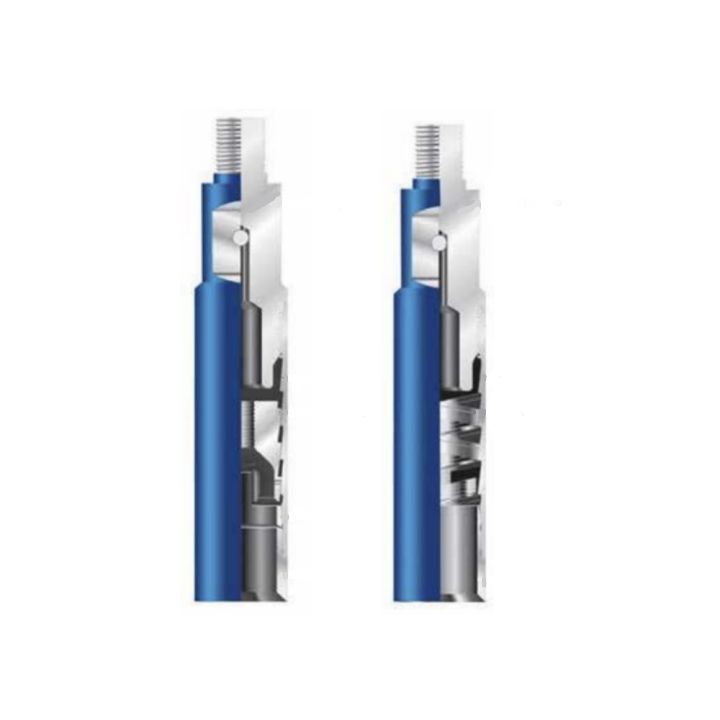
Float valve joint is one of the necessary tools for oil drilling. The float valve joint is connected to the upper part of the drill bit, and the float valve assembly in the joint is close to the connection thread of the drill bit. It can also be connected where the drill string requires it. Its main functions are: to prevent mud from being brought into the drilling cuttings and mud from flowing back when connecting a single drill bit, blocking the water hole of the drill bit; When a blowout or kick occurs, the valve cover of the float valve assembly automatically closes the water hole, preventing blowout prevention accidents in the pipe string.
Float valve joint is one of the necessary tools for oil drilling. The float valve joint is connected to the upper part of the drill bit, and the float valve assembly in the joint is close to the connection thread of the drill bit. It can also be connected where the drill string requires it. Its main functions are: to prevent mud from being brought into the drilling cuttings and mud from flowing back when connecting a single drill bit, blocking the water hole of the drill bit; When a blowout or kick occurs, the valve cover of the float valve assembly automatically closes the water hole, preventing blowout prevention accidents in the pipe string.
Bypass valve
When overflow occurs during drilling and the water hole in the drill bit is blocked, the bypass valve can be opened for circulation or well killing. Before drilling a hydrocarbon reservoir, it is necessary to connect the bypass valve to or near the drill bit.
When overflow occurs during drilling and the water hole in the drill bit is blocked, the bypass valve can be opened for circulation or well killing. Before drilling a hydrocarbon reservoir, it is necessary to connect the bypass valve to or near the drill bit.
Pressure test plug
The pressure testing plug is a plugging tool used for pressure testing of casing strings and blowout preventers in drilling and mining fields. For oil, gas, and water wells that have already run casing and installed wellhead equipment, one-time layered pressure testing of the casing and blowout preventer stack is simple and reliable. The leather cup assembly of this tool is made of special high-quality rubber material.
The pressure testing plug is a plugging tool used for pressure testing of casing strings and blowout preventers in drilling and mining fields. For oil, gas, and water wells that have already run casing and installed wellhead equipment, one-time layered pressure testing of the casing and blowout preventer stack is simple and reliable. The leather cup assembly of this tool is made of special high-quality rubber material.