
How does a multi-activation bypass valve work?

Introduction: In our last issue, we discussed the urgent need for through-bit lost circulation control and high-rate hole cleaning without tripping. In this issue, we will dive straight into "dissecting" a tool highly favored in oil and gas engineering—the Tianhe Multi-Activation Bypass Valve—to show you its internal structure and ingenious ball-controlled operating principle.
I. Precision Upgrade: High-Durability Internal Mechanical Structure
The Tianhe Multi-Activation Bypass Valve is a classic on-off sub system, typically deployed above specialized bottomhole assemblies (BHAs) for directional drilling, performance drilling, and logging-while-drilling (LWD). To maintain long-term stability in extreme downhole environments characterized by high temperatures and severe erosion, the Tianhe engineering team has optimized several core materials and structural components:
Structural Core: It primarily consists of a top sub, bottom sub, bypass nozzles (carbide nozzles), locking pins, an internal sliding sleeve, a compression spring, a ball seat, a ball basket, and a retaining ring, all precisely integrated.
Erosion-Resistance Upgrade: The sliding sleeve material has been upgraded to 17-4PH (630 stainless steel) to enhance the erosion resistance of its bypass ports. Concurrently, the nozzle material was changed to YG11C tungsten carbide, significantly increasing the erosion resistance of the bypass ports on the top sub.
Mechanical and Thermal Breakthroughs: The top sub material was switched to high-strength 4330V, comprehensively improving the tool's mechanical properties. The control balls (deactivation/locking balls and activation balls) have been fully upgraded to PEEK material, ensuring the tool can operate at temperatures up to 150°C.
Sealing and Maintenance Optimization: The seals between the sliding sleeve and the top sub were upgraded from standard O-rings to Y-rings, drastically improving sealing stability and service life. Additionally, O-rings were added to both sides of the retaining ring threads to prevent mud ingress, ensuring the retaining ring can be easily disassembled during maintenance.
II. Operational Mode: Ingenious Control Ball Trajectory
The opening and closing of the Tianhe Multi-Activation Bypass Valve requires no complex external controls; it is precisely operated from the surface through a simple process of "dropping balls + controlling pump pressure":
Step 1: Normal Mud Circulation: In the initial state, the sliding sleeve covers the bypass ports, allowing normal mud circulation to flow downward through the string.
Step 2: Drop the Activation Ball (Open Bypass): A PEEK activation ball is dropped into the drill string. Once the activation ball seats, it pushes the sliding sleeve downward. When the pump pressure reaches approximately 0.5–1.0 MPa, the bypass ports open completely, allowing drilling fluid to discharge directly from the side of the tool into the annulus.
Step 3: Drop the Locking Ball and Closing Balls (Prepare for Closure):
- First, a locking (deactivation) ball is dropped. Once it lands and plugs one of the bypass ports (stopping fluid flow), the test pump is shut down in a timely manner. At this point, the bypass port not plugged by the locking ball remains open.
- Next, two GCr15 bearing-steel closing balls are dropped, and the pump is started at a low stroke rate. One of these closing balls will plug the open bypass port (while the other bypass port is already plugged by the locking ball), causing the pump pressure to rise.
Step 4: Pressure Build-up, Shearing, and Reset for Full Flow:
- When the pump pressure reaches approximately 7–9 MPa, the locking ball is sheared through the bypass port and exits to the outside of the bypass valve (the actual pressure must be recorded). The second closing ball will quickly move in to plug this newly vacated bypass port, and the pump pressure continues to rise.
- When the pump pressure reaches approximately 10–13 MPa, the activation ball is sheared and passes through the upper ball seat (the actual pressure must be recorded). The activation ball and the two closing balls eventually drop safely into the ball basket below, restoring full through-bore circulation inside the bypass valve. At this point, the sliding sleeve resets, and the system returns to normal mud circulation.
Switching Cycle Life: A single tool kit comes equipped with 6 ball sets, each containing 1 activation ball, 1 locking ball, and 2 closing balls (4 balls per set). Configured with these 6 sets, the tool is rated to provide 6 complete downhole switching cycles within a single trip, meeting the operational requirements for multiple activations and lost circulation control.
 Join Tianhe Oil at Xinjiang Petroleum & Chemical Expo 2026
  What value does the Multi-Activation Bypass Valve deliver?
  Multi-Activation Bypass Valve Industry Pain Points & Core Functionality
  An In-Depth Breakdown of Cased-Hole Sidetracking: Racing Through the Steel Wall
  Downhole "Surgery": How Casing Side-Tracking Breathes New Life into Damaged Wells
  New application example of high speed and high power screw drilling tool of TRW Petroleum
  Tianhe directional well product practical case
  The company passed the review of QES system certification
  In 2021, the first batch of high-tech enterprises were approved
 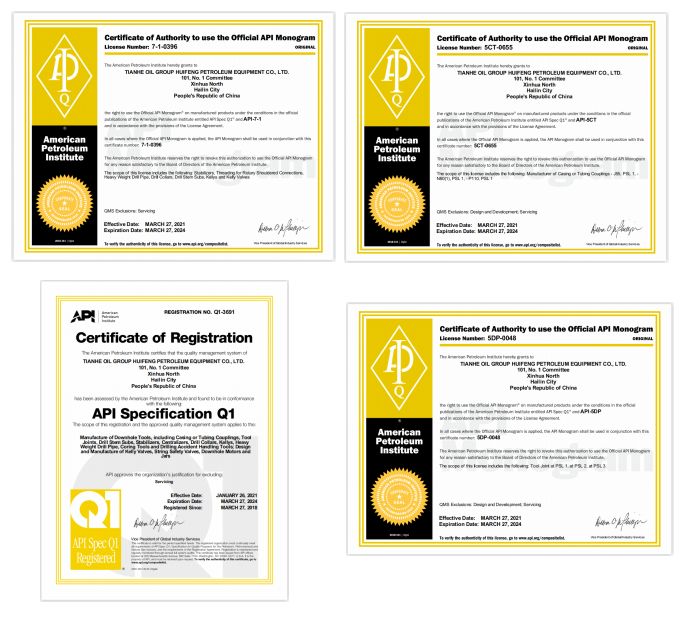 API external audit